

Winter concreting in the Nordics starts well before the first snow. Swedish practice treats concrete as being in winter once the daily mean temperature falls below +5°C. From that point, every pour needs protection from cold and wind. On a hyperscale data centre, that covers a large share of the year and shapes the whole substructure programme.
When Does Winter Concreting Start?
Swedish contractors call it the concrete winter. It begins when the daily average drops below +5°C, and it runs until spring. As a result, it lasts far longer than the calendar winter. In much of Sweden it stretches from autumn deep into spring, and further north it runs longer still.
That matters for planning. A programme that assumes winter concreting only from December will be wrong by months.
What Happens if Fresh Concrete Freezes?
The rule is simple. Fresh concrete must not freeze before it reaches a compressive strength of about 5 MPa. The Swedish Concrete Association notes that in reasonable conditions this happens within the first day. However, once the concrete cools early, hardening slows sharply.
If it freezes too soon, the damage is permanent. Swedish supplier guidance warns that strength can fall by 50% or more, often with no visible sign. On a data hall slab that carries racks, plant and raised floors, that is not a risk anyone accepts.
How Is Winter Concreting Done on a Hyperscale Slab?
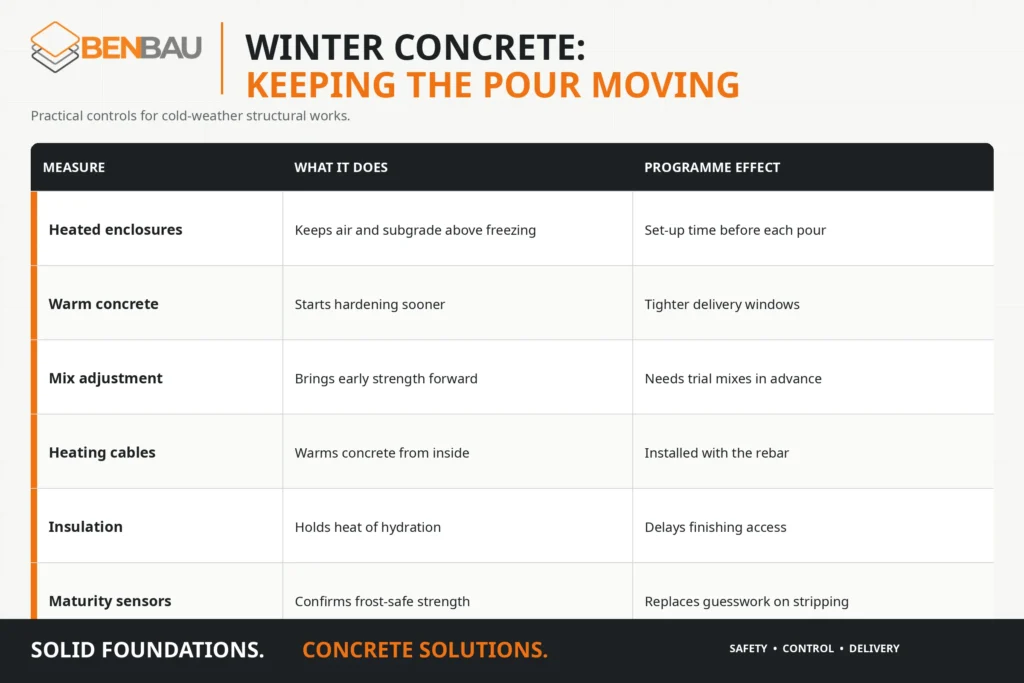
Heated Enclosures: Tents or temporary structures over the pour area, heated before and after placing. The formwork and subgrade stay free of snow and ice.
Warm Concrete: Heated water and aggregate at the plant, so the mix arrives warm. Transport time matters, particularly on remote greenfield sites.
Mix Adjustment: A lower water-cement ratio, accelerators or frost protection admixtures bring early strength forward.
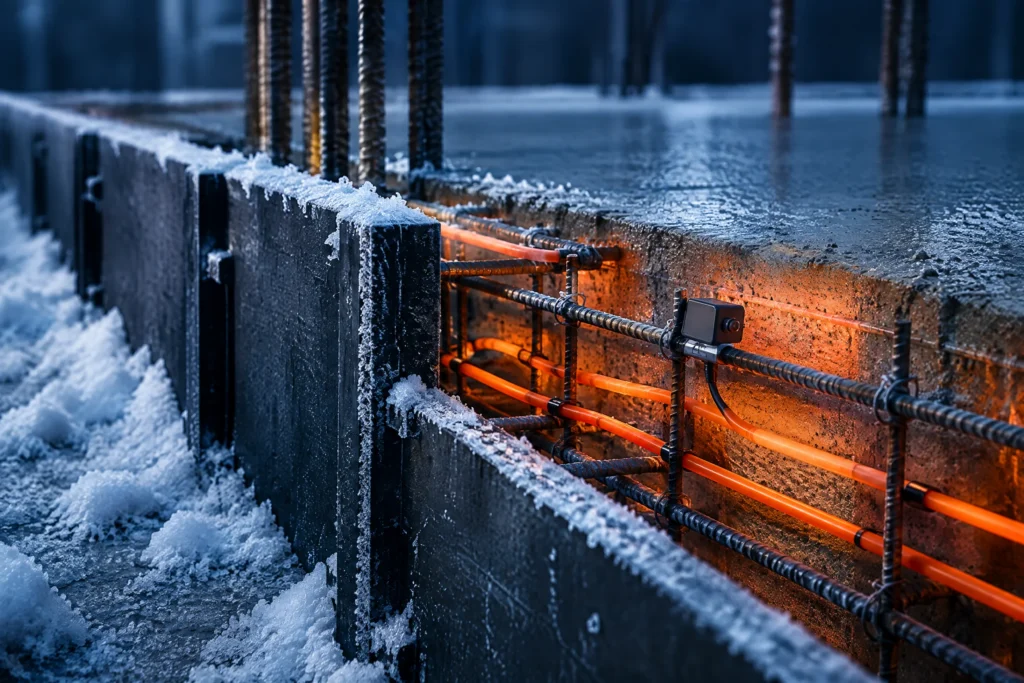
Cast-In Heating Cables: Cables placed in the pour keep the concrete warm from inside. They are common in Swedish practice for walls, plinths and thinner sections.
Insulation: Insulating mats go on straight after finishing. The aim is to hold the heat the concrete produces as it hardens.
Ground Preparation: Nobody pours on frozen ground. The subgrade is covered and heated in advance, and rebar must be free of ice.
Maturity Monitoring: Temperature sensors in the slab track strength gain in real time. So the team knows when the concrete is safe from frost, and when forms can come off.
How Winter Concreting Changes the Programme
Cold slows everything. Strength develops more slowly, so form stripping and power floating take longer. Short daylight also cuts productive hours, and in northern Sweden the December day is only a few hours long.
For that reason, developers often plan to finish groundworks and slabs before the hard frost rather than through it. Where that is not possible, the winter concreting method has to be in the tender price. Adding it later as a variation is where cost and programme disputes start.
Pour sizes may change too. A large slab pour that works in August may need splitting in January, simply because the enclosure and heating cannot cover it all at once. See our guide to the data centre construction timeline for where the slab sits in the wider build.
Low-Carbon Mixes and the Cold
Hyperscale clients increasingly ask for low-carbon concrete. Mixes that replace part of the cement with slag or other binders cut embodied carbon. However, many of them gain strength more slowly, and cold slows them further.
This creates a real tension in winter. The mix that meets the carbon target may not reach frost-safe strength fast enough without extra heat. So mix design, heating and carbon targets need agreeing together, ideally with trial pours before the season starts.
Our own record covers 435,000 m² of slabs, 200,000 m³ of concrete and 22,500 tonnes of rebar, across eleven completed hyperscale packages in Sweden with five more live.
Frequently Asked Questions
At what temperature does winter concreting start? When the daily mean temperature falls below +5°C. Swedish practice treats all pours from that point as winter pours.
What strength must concrete reach before it can freeze? About 5 MPa. Below that, freezing can cause permanent strength loss of 50% or more.
Can you pour concrete at minus temperatures? Yes, with heated enclosures, warm concrete, adjusted mixes and insulation. The concrete itself must stay above freezing until it is frost-safe.
Does winter concreting delay a data centre programme? It slows strength gain and cuts daylight hours. Planned properly, it costs time and money but does not stop the build.
Do low-carbon mixes work in winter? Yes, but many gain strength more slowly in the cold. They need extra heat or mix trials. See why hyperscalers build in the Nordics.