
Data centre construction in Germany and Sweden follows the same basic sequence. The rules around it do not. Germany brings heavier permitting and a strict national energy law. Sweden brings faster consent and a harder winter. Labour registration, site access and safety roles also change at the border.
How Does Data Centre Construction in Germany Differ From Sweden?
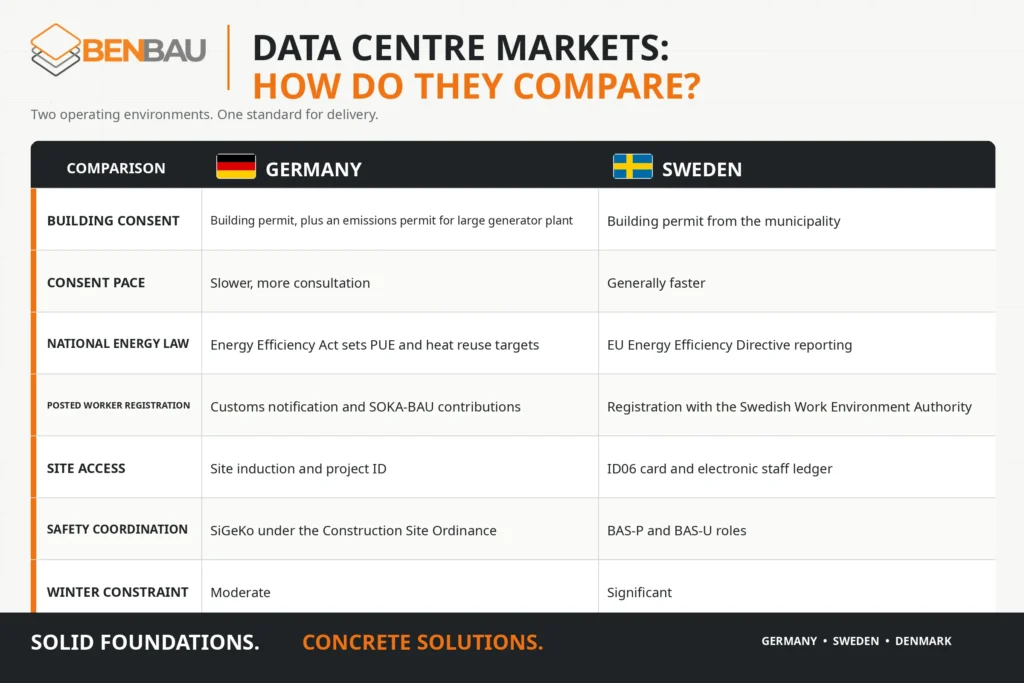
The slab, the rebar and the pour sequence look much the same in both markets. What changes is everything around them. The table sets out the main differences a concrete contractor meets on site.
Permits and Consent for Data Centre Construction in Germany
Data centre construction in Germany carries the heavier consent load. A hyperscale scheme usually needs a building permit and a separate emissions permit for the backup generators. Public consultation adds time. In addition, around two-thirds of German projects now sit outside the major cities, where local authorities see the building type less often.
Sweden moves faster. Local councils grant building permits under the Planning and Building Act, and several have competed hard for data centre investment. Still, large generator plant can trigger environmental review there too.
For the concrete package, consent mostly sets when work can start. Once on site, the pour programme follows the same logic in both markets.
What the Energy Efficiency Act Means for Data Centre Construction in Germany
Germany’s Energy Efficiency Act sets limits Sweden does not. Under the Act as it stands, new data centres opening from 1 July 2026 must reach a PUE of 1.2 and reuse at least 10% of their energy. The reuse share then rises to 15% from July 2027 and 20% from July 2028.
However, the law is moving. The federal cabinet approved an amendment in June 2026. It keeps the 1.2 limit for new builds but gives operators four years instead of two to reach it. It also adds exemptions to the heat reuse rules. Until parliament passes it, the current Act applies.
For a contractor this matters in two ways. First, a lower PUE target shapes the cooling design, and with it the plant loads and plinths the slab has to carry. Second, where a scheme commits to heat reuse, it adds below-ground work: pipe routes, connection structures and plant space. Both belong in the tender drawings, not in a later variation.
Site Labour and Compliance
Posted Workers: Both countries require notice before foreign crews start. Germany adds customs notification and, for construction, contributions to the SOKA-BAU holiday fund. Sweden requires registration with the Work Environment Authority and a named contact person in the country.
Site Access: Swedish sites run on ID06 cards linked to an electronic staff ledger that the tax agency can inspect. German sites rely more on project-level induction and ID. As a result, the admin sits in different places, but neither market tolerates gaps.
Safety Roles: Germany appoints a health and safety coordinator, known as SiGeKo, under the Construction Site Ordinance. Sweden splits the role into BAS-P for design and BAS-U for execution. The duties overlap, but the paperwork does not transfer.
Climate and Programme
Sweden’s winter is the bigger programme risk. Heated enclosures, an adjusted mix and a revised curing regime are standard from late autumn. So most Swedish programmes aim to finish groundworks and slab before the hard frost arrives.
Winters are milder for data centre construction in Germany, particularly around Frankfurt. Even so, cold weather concreting still needs a written method, and short daylight affects crew output in both markets.
Our own record covers 435,000 m² of slabs, 200,000 m³ of concrete and 22,500 tonnes of rebar, across eleven completed hyperscale packages in Sweden with five more live.
Frequently Asked Questions
Is data centre construction in Germany slower than in Sweden? Consent usually takes longer in Germany. The build itself runs at a similar pace once work starts. See our guide to the data centre construction timeline.
What PUE must new German data centres reach? Under the current Energy Efficiency Act, 1.2 for data centres opening from 1 July 2026. A 2026 amendment keeps that limit but extends the deadline to reach it.
What is ID06? The Swedish construction ID card system. Workers use it to register on site, and it links to the electronic staff ledger.
Do foreign construction firms pay into SOKA-BAU? Firms posting construction workers to Germany generally have to contribute to the SOKA-BAU holiday fund.
Why build data centres in Sweden rather than Germany? Faster consent, renewable power and a cool climate. See why hyperscalers build in the Nordics.